03The Dreamers
Sleep as frontier and escape
The focus is not on people as subjects, but on what they build in order to afford the dream: sleep as frontier and escape.
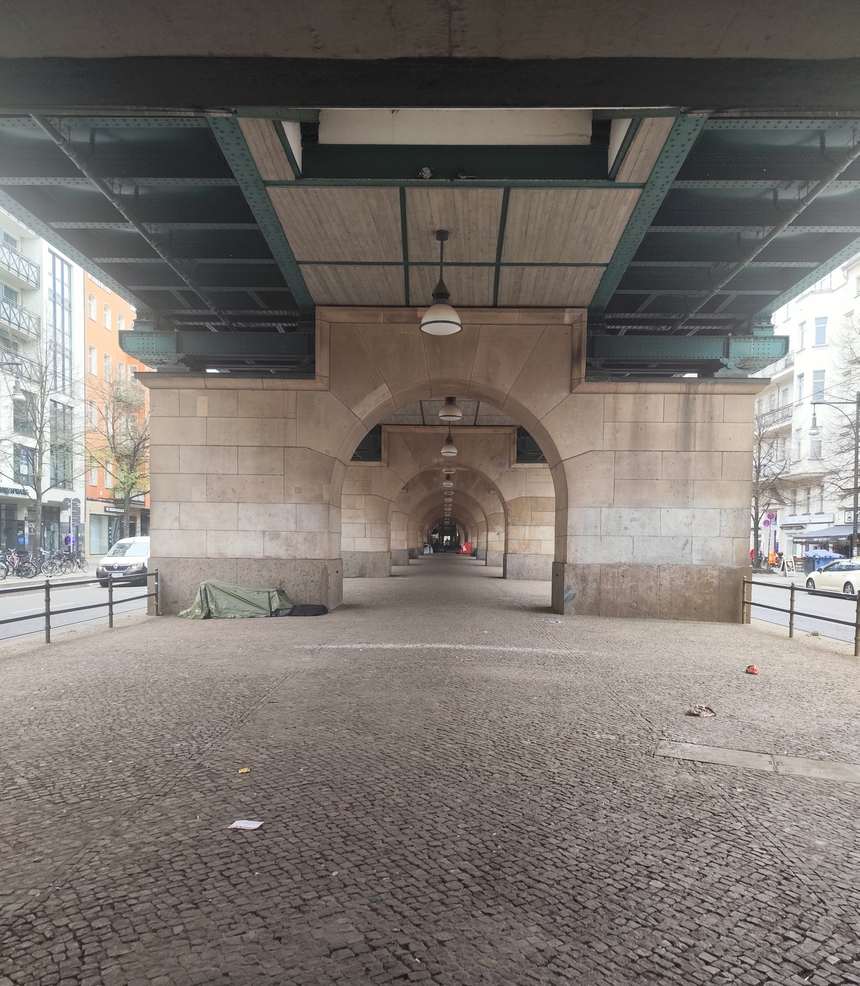
Spatial research on ExistenZmaximum
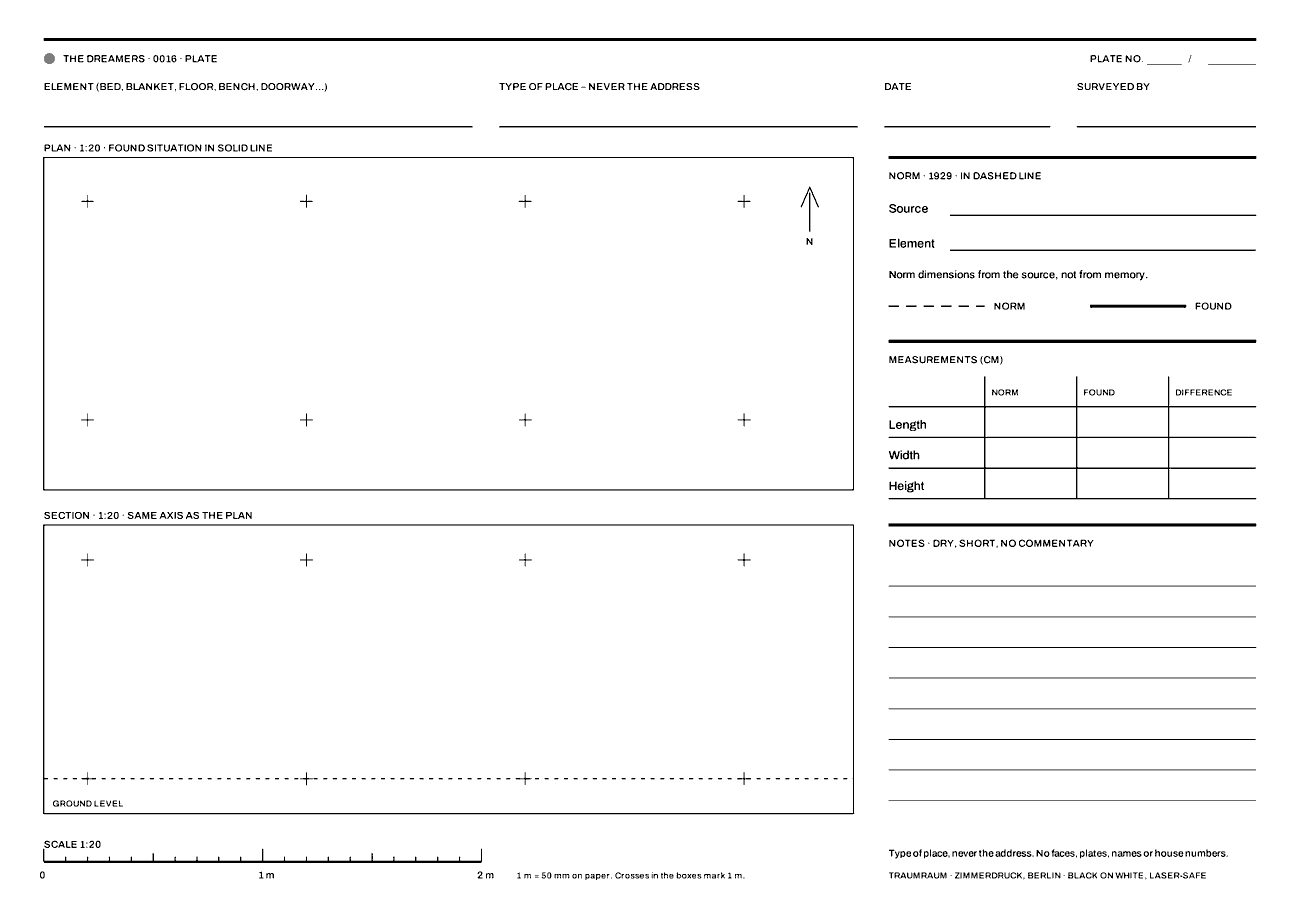
The work is planned as an atlas of plates. It follows the order of Georges Perec's Species of Spaces, from the bed to the street, and takes from Rem Koolhaas's Elements of Architecture the method of one element at a time. The elements are chosen for the places where people sleep: bed, blanket, floor, bench, doorway. Each is measured on site, drawn in plan and section at 1:20, and set against the minimum dwelling of 1929, the Existenzminimum.
The modern promise was a minimum to exist: a bed, a window, a door. The city discards those who do not fit, who do not produce, who do not buy. They end up on a bench, in a doorway. But sleep remains the one place capitalism has not yet taken: a free zone, a small escape. As a provocation, I call it the ExistenZmaximum: not the minimum to survive, but the most that is left. A place to dream.
The oldest story I know about sleeping as a way out is the Seven Sleepers of Ephesus. In 250, the emperor Decius orders everyone to sacrifice to the Roman gods. Seven young Christians refuse and hide in a cave outside the city. They fall asleep. The soldiers wall them in. When the cave is opened, more than a century later, they wake up hungry and try to buy bread with coins nobody uses any more. The Christian tradition gives them between 128 and 200 years of sleep; the Qur’an about 300. Here, sleep is not rest. It is the only door left.
| Category | Research |
|---|---|
| Method | Measured plans and sections at 1:20 of places where people sleep, drawn against the 1929 minimum dwelling. No people and no addresses are recorded. |
| Status | In progress. Survey method in development |
| Place | Berlin |
| Year | 2026 – ongoing |
Sources
- Crary, Jonathan. 24/7: Late Capitalism and the Ends of Sleep. London: Verso, 2013.
- Dellenbaugh, Mary, Markus Kip, Majken Bieniok, Agnes Katharina Müller, and Martin Schwegmann, eds. Urban Commons: Moving Beyond State and Market. Bauwelt Fundamente 154. Gütersloh: Bauverlag; Basel: Birkhäuser, 2015.
- Economopoulos, Nikos. Homeless Kurds in Istanbul. 1989. Photograph. Magnum Photos.
- Internationale Kongresse für Neues Bauen and Städtisches Hochbauamt Frankfurt am Main, eds. Die Wohnung für das Existenzminimum. Frankfurt am Main: Englert & Schlosser, 1930.
- Kiš, Danilo. “The Legend of the Sleepers.” In The Encyclopedia of the Dead, translated by Michael Henry Heim. New York: Farrar, Straus and Giroux, 1989.
- Koolhaas, Rem, and Harvard Graduate School of Design. Elements of Architecture. Cologne: Taschen, 2018.
- Korbi, Marson, and Andrea Migotto. “Between Rationalization and Political Project: The Existenzminimum from Klein and Teige to Today.” Urban Planning 4, no. 3 (2019): 299–314.
- P. M. “Die Wohnung für das Existenzminimum.” Schweizerische Bauzeitung 95/96, no. 2 (1930): 24–25.
- Perec, Georges. Espèces d’espaces. Paris: Galilée, 1974.
- Qur’an. Surat al-Kahf (The Cave), 18:9–26.